

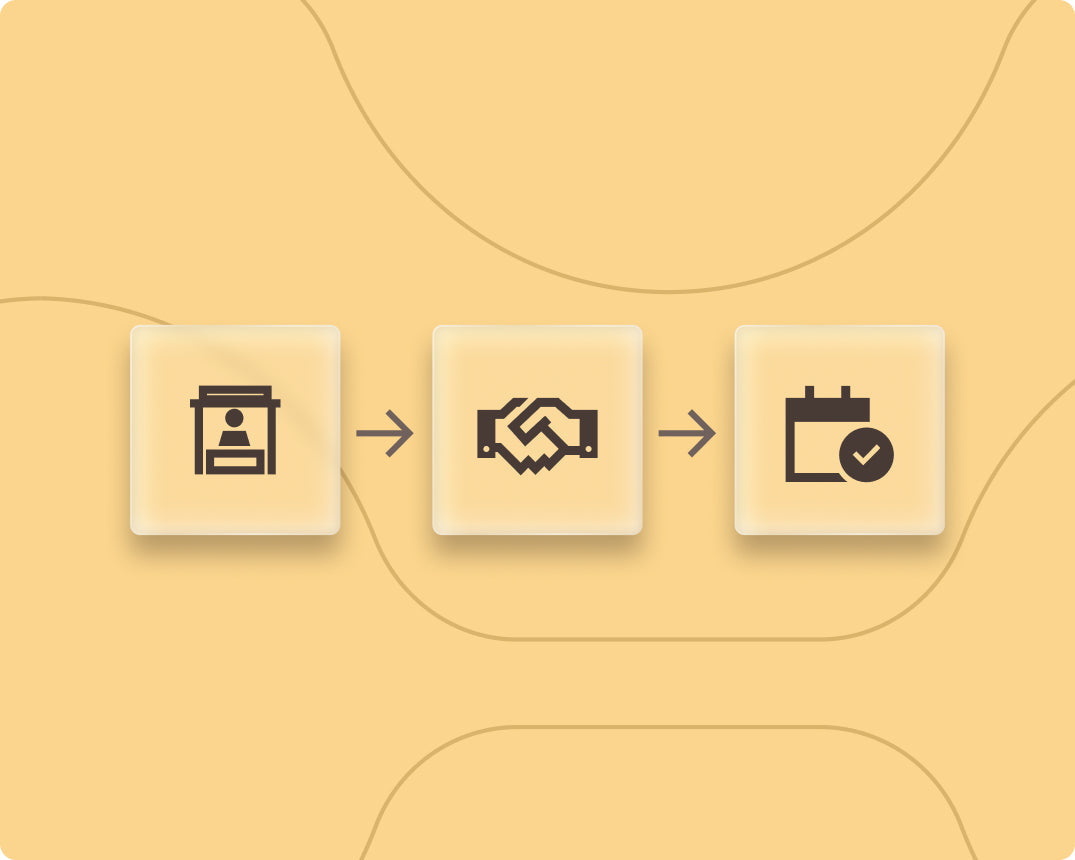
Your reps just worked three days on a packed show floor — hundreds of badges scanned, dozens of conversations. A handful were the real thing: the prospect leans in, describes their exact problem, and asks how you'd solve it.
That's the most valuable moment on the floor because 67% of trade show attendees are completely new prospects. [1] And yet, the handoff from "great conversation" to "booked demo" is exactly where most of the event pipeline quietly disappears.
The numbers aren't pretty: up to 80% of trade show exhibitors never follow up on their leads. [2] When follow-up does happen, it's often too late. By the time the demo invite goes out days after the show, the buyer has talked to four other vendors and can barely place your conversation.
So booking a demo at a trade show really comes down to two jobs. First, lock in the meeting while you're still standing in front of the buyer. Second, make sure they show up. This playbook shows you how to ace both.
Why trade show demos don’t get booked

A demo is a bigger ask than a business card or a quick chat. It’s thirty minutes of focused attention from someone already stretched thin, walking a floor where a hundred other booths compete for the same time.
So when a rep offers to “set something up later,” the prospect almost always says yes. Saying yes to later costs them nothing.
The problem with putting off booking the demo
Field marketers describe the same scene, show after show: a prospect is interested but not ready to commit on the spot. The rep offers a soft, “Let’s do a deeper dive after the event.” But that demo never gets scheduled.
One enterprise team watched it play out at a flagship conference. They had strong, high-intent conversations across three days and projected hundreds of thousands in pipeline, yet walked away with zero booked demos and nothing concrete to show leadership.
Why the follow-up email fails to secure the demo
The follow-up email rarely rescues the conversation because interest wanes between the handshake and the inbox. The slide starts the moment the prospect leaves your booth, and it’s steep: 90% of leads go inactive within 30 days. [3]
By the time your “great to meet you” message lands, the energy of the conversation is gone, and the problem the buyer described is buried under everything that piled up while they were away.
And the math compounds. Raw event leads convert at a modest rate when nothing’s locked in early: only about 24% of trade show leads become marketing-qualified leads. [4] A demo booked on the floor skips that intent decay entirely because the lead never gets the chance to cool.
Secure the demo on the show floor

Booking on the floor isn't about speed for its own sake. It's about being first.
Whoever's first usually wins
When a buyer leaves your booth interested, you're not the only vendor they spoke to that day, and you won't be the only one who follows up. Half of all leads end up working with whichever company reaches them first. [5]
A demo confirmed on the spot makes you the first-mover by default, while everyone else is still drafting next Monday's email. The most prepared teams get a head start before the floor even opens, booking meetings from an enriched attendee list in advance.
That's why leading event lead capture platforms now build calendar booking right into the badge scanner app, so reps can lock the next step without leaving the conversation. Popl built Calendar Booking for exactly this moment. As Popl CPO Ryan Alvarez-Cohen puts it, when a conversation ends without a meeting on the calendar, "the momentum from that connection starts to fade."
Make the ask before they walk away
Booking the meeting is one motion, not a separate task. The rep taps the calendar icon on the lead they just scanned, the scheduling link opens with the prospect's details already filled in, and the buyer picks a time before walking away.
Because the mechanics stay out of the way, the ask stays conversational: "I'd love to walk you through exactly how we'd solve that. Can we grab thirty minutes while we're both here?" Said in the moment, with the problem still fresh, it lands.
One computer hardware reseller's team put it plainly: at a busy conference, prospects often don't remember a conversation at a booth later. A meeting locked on the spot beats an email asking for one.
Securing the demo is half the job. The other half starts the second they say yes — because a booked demo only matters if the prospect shows up. Four levers decide whether they do.
Show-up lever 1: Qualify the demo properly

The biggest reason prospects don't show up to demos is that the meeting never should have been booked in the first place. An unqualified yes is a no-show waiting to happen.
So the single most effective thing a rep can do to protect show-up rates is to qualify before making the ask. There's a well-worn framework for exactly this: BANT, which stands for Budget, Authority, Need, and Timeline. It originated at IBM and remains the standard first-pass screen in B2B sales. [6]
Here's what each piece tells you, and why it matters on a show floor.
Budget
Can the prospect fund a purchase, or at least influence the people who can? You won't settle pricing at a booth, but a quick sense of whether the money is there keeps you from booking demos that stall the moment cost comes up.
Authority
Can the prospect act on what they see in the demo? Events are unusually strong on this front because most booth visitors hold real buying power. Roughly 81% of trade show attendees have purchasing authority, a rare concentration of reachable decision-makers. [7] Reading who owns the decision tells you whether the demo is worth a calendar slot.
Need
Does the prospect have a real problem your product solves? At a trade show, this is the easiest signal to read because the buyer usually names the problem themselves during the conversation. No stated problem, no demo.
Timeline
Is there a reason to buy now? Urgency is a qualifier, not a nice-to-have. A buyer who needs a solution within the next 90 days is far more likely to request a proposal after the demo, and many attendees are already close: 46% are in the final stages of a buying decision. [8] On the floor, the timeline is what separates a curious browser from a buyer with a clock running.
BANT gives you the structure. The real skill at an event is running it fast enough to fit inside a booth conversation.
How Popl’s sales team uses BANT
Popl's own sales team adapts BANT for the pace of a show floor, where there's no time for a deep procurement conversation and the strongest signals are the ones a buyer hands you in the moment.
On top of the classic four, the team layers in the extra context that a generic screen misses, such as whether a company attends enough events to derive lasting value from what you sell. That's the difference between a qualified lead and a qualified lead who renews.
The mechanics make it stick. Capture the answers as you talk, tag them to the lead, and let that context carry over into your CRM and the demo.
Show-up lever 2: Incentivize the demo

Incentives work, but only when they're tied to the action you want. A giveaway is great at pulling people in, and 52% of attendees are more likely to visit a booth when one's on offer. [9] But hand the same item to everyone who passes by, and you attract people who came for a free power bank, not a demo.
The fix is to tier your incentives. A low-cost item for a quick booth chat is fine. Reserve the premium reward for the action that signals real intent: booking or completing a demo.
That premium reward can take several forms: a high-quality gift for completing the demo, early access to a new feature, an executive briefing slot, or entry into a meaningful prize draw for prospects who show up. Each one raises the cost of a no-show without cheapening the conversation.
A good incentive also keeps your brand top of mind in the days between booking and the demo, since around 85% of attendees recall the company behind a promotional item. [9] Pair that with the qualification bar from lever one, and you're rewarding the right people for the right behavior.
Show-up lever 3: Customize the demo

The qualification context from lever one pays off again here. Use what the rep captured at the booth to build the demo around the buyer's problem: tailor the agenda, name the stakeholders who should attend, and send a short pre-demo note that references the exact problem they raised.
A demo built around a specific problem has higher show-up rates than a generic product tour because the prospect can picture what they'll get out of it.
The payoff doesn’t stop there. Interactive, tailored demos close at roughly 38% versus about 25% for a generic walkthrough. [10]
The stakes climb with consultative buyers. For example, one marketing leader we spoke to said his team isn't selling a simple widget, so every touch has to reflect the specific conversation. For a buyer like that, personalization isn't a courtesy. It's the difference between a demo they protect on their calendar and one they quietly drop.
You can even make sure the right person runs the demo. For example, with Popl’s native Calendar Booking, the rep can drop in a product specialist’s calendar link. When prospects ask detailed questions about features on the floor, the rep can ensure they’re answered during the demo. The right expert running the demo lifts both the show rate and the outcome.
Show-up lever 4: Send demo reminders

The last lever is the simplest and the most overlooked. A confirmation the moment a demo is booked, followed by a reminder a day or two out, measurably protects the meeting.
The strongest evidence comes from healthcare, where no-shows have been studied for decades. A systematic review of 29 studies found that reminders reduce missed appointments, with nearly every study showing a clear benefit. [11] Adding a second reminder on top of the first reduces no-shows further still, which is why a short cadence beats a single message. [12]
The principle travels cleanly to B2B. A timely, easy-to-confirm reminder keeps your demo on the buyer's radar through the noise of the week after the show.
Putting it to work starts with making sure your sales and marketing stack knows the moment a demo is booked. Popl's Calendar Booking, for example, stamps the booked demo and syncs that record to your CRM, so the meeting is logged the second the buyer commits.
From there, let your scheduling tool carry the cadence. Whether the rep booked into Calendly, Chili Piper, or another tool, the scheduler can send the confirmation and reminders automatically.
None of it is heavy lifting. The booking creates the record, the scheduler sends the reminders, and the demo stays on the buyer's calendar through the post-show scramble.
Track demos booked and completed, not just badge scans

You can't coach what you can't see. Most teams leave a show knowing how many badges they scanned, but not how many demos those conversations produced. Meetings booked is the metric that points most directly to revenue, which makes it the last one you want to rebuild by hand after the show.
One enterprise team we talked to said they had to spend four days reconstructing event reporting for leadership, with no meetings-booked figure to show for it. That line was always missing, and it's the one finance reads first.
The fix is to capture the number at its source, the moment a demo gets booked. That's one reason in-app calendar booking earns its place in a lead capture app: when a rep books from the floor, the meeting can be logged against that rep and that event automatically. Popl's Calendar Booking, for example, stamps each booked demo and syncs it to your CRM, so booked meetings become a real metric alongside leads captured and pipeline, not something your team pieces together after the show.
From there, the coaching conversation changes. It moves from "how many badges did we scan" to the questions that map to revenue: how many demos each rep booked, how many of those were completed, and how much pipeline came out the other side.
Take leads from booth to booked in seconds with Popl

Securing the demo and getting the prospect to show up are two jobs. Popl helps reps get both done from the show floor.
The rep scans the badge with Popl's Universal Badge Scanner, the lead enriches in seconds, and a few qualifying questions confirm the demo is worth a calendar slot. The rep books it on the spot through their existing scheduler or the right teammate's.
From there, nothing slips. Every booked demo is tracked by rep and by event, and every lead syncs straight to Salesforce or HubSpot, so you get the complete picture of team and event performance.
Close the gap between the conversation and the calendar, and it shows up where it counts: more demos booked and completed, which means real event pipeline to show leadership. It's why 90% of the Fortune 500 trust Popl to capture leads and book demos at their events.
See how Popl helps reps turn booth conversations into booked demos today. Request a custom walkthrough of Calendar Booking.
Frequently asked questions
1. How do you book more demos at trade shows?
Book during the conversation, not after it. Qualify the prospect in two or three quick questions, make the demo ask while interest is high, and use a one-tap booking flow that opens your scheduler with the prospect’s details already filled in. The shorter the gap between a strong conversation and a confirmed demo, the more demos you book because half of buyers go with whoever reaches them first.
2. How do you qualify a lead for a demo on the show floor?
Run a fast, BANT-style screen built for the booth: does the prospect have a defined problem you can solve, do they have authority to act on it, do they have the budget for your solution, and is there an urgent reason to buy now?
If the answers line up, make the ask. If they don’t, keep the conversation friendly and skip the calendar.
3. How do you reduce demo no-shows after the trade show?
Use these four levers to reduce demo no-shows after the trade show: qualify prospects before booking the demo, so only right-fit prospects fill your calendar. Incentivize showing up to the demo with a desirable gift. Customize the demo around the buyer’s specific problem, so they can picture the value. Finally, send a confirmation email right after booking the demo, then another the day before the meeting.
4. Should you offer an incentive to book a demo at a trade show?
Yes, but tier it. A small item is fine for a quick chat, while the premium reward should be reserved for prospects who book or complete a demo. Tying the incentive to a qualifying action attracts buyers rather than freebie-seekers, and keeps your brand memorable before the demo.
5. How do you track demos booked at events?
Use a system that logs each demo against the rep who booked it and the event where it was scheduled. That way, you can track performance across your team and events. Reward your all-stars, coach struggling reps, and fill your calendar with events that deserve the budget.
Sources
[2] Salesforce Training, “Are Your Salespeople Squandering Tradeshow Leads?” (2012)
[3] Ricochet360, “Lead Management Infographic” .
[4] First Page Sage, “Lead-to-MQL Conversion Rate Benchmarks by Industry and Channel” (2025)
[5] InsideSales.com (research by Dr. James Oldroyd), via Geckoboard, “Lead Response Time”
[6] Salesforce, “BANT vs. MEDDIC: Comparing Sales Qualification Methodologies”
[7] CEIR, via Cvent, “47 Trade Show Statistics”
[8] Trade Show Labs, “150+ Trade Show Statistics for 2026”
[9] Perfect Imprints, “20 Best Experiential Tradeshow Giveaways”
[10] Optifai, “Demo-to-Close Rate Benchmarks” (analysis of 939 B2B companies)
